
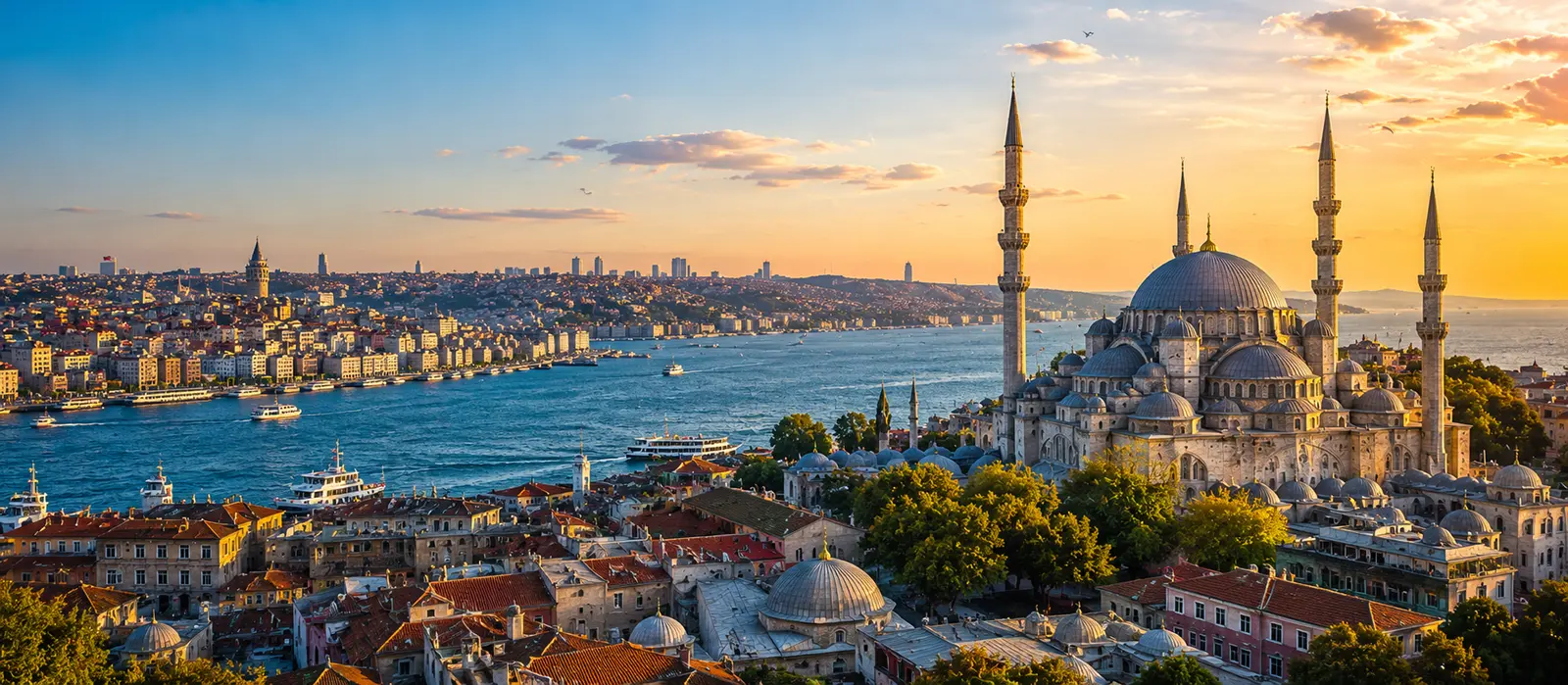
Should You Stay Only Around Sultanahmet?
Sultanahmet can introduce Istanbul, but it cannot contain it.
No—not for most trips. Sultanahmet is one of the world’s strongest concentrations of historic monuments, but staying and exploring only there can make one specialized district appear to represent all of Istanbul.
Choosing a hotel in Sultanahmet may be sensible. Limiting every day, meal, walk, and evening to its immediate visitor zone is a different decision.
Sultanahmet can introduce Istanbul, but it cannot contain it.
Smart Tip
If Sultanahmet is your base, protect its main advantage: walk to one major attraction early. Then build at least one day around a contrasting center such as Beyoğlu, Beşiktaş, Kadıköy, or Üsküdar. Do not commute back after every single stop; explore the second area as a complete neighborhood.
Staying in Sultanahmet and staying only in Sultanahmet are different
Accommodation answers where you sleep. Exploration answers which versions of Istanbul you encounter.
A traveler can sleep near Hagia Sophia, begin early around the historic peninsula, then use tram, metro, walking, or ferry connections to spend long blocks elsewhere. The hotel remains convenient without defining the entire trip.
Confusing these decisions turns a useful base into an invisible boundary.
The first monumental center can anchor the whole interpretation
Sultanahmet presents Istanbul at maximum historical concentration: domes, minarets, imperial architecture, archaeological layers, museums, queues, guides, and multilingual visitor services appear within a relatively compact area.
This can create heritage anchoring. Later neighborhoods are judged by how much they resemble or depart from that first image.
The danger is not that Sultanahmet is inauthentic, but that its exceptional concentration is mistaken for normal citywide life.
Sultanahmet earns its place in a first visit
Hagia Sophia, the Blue Mosque, Topkapı Palace, the Basilica Cistern, the Hippodrome area, archaeological remains, and nearby museums can justify substantial time. The district allows visitors to encounter several major historical periods without a long morning transfer.
Staying nearby can make early arrival easier, provide a midday hotel break, and reduce the pressure to finish large sites before crossing the city.
The answer is not to rush through Sultanahmet in order to prove sophistication. Its density deserves attention.
| Traveler priority | Sultanahmet advantage | Possible limitation | Useful response |
|---|---|---|---|
| First historic visit | Walkable access to major monuments | The district can dominate the entire image of Istanbul | Add one contrasting neighborhood day |
| Very short stay | Low morning travel cost | Little time remains for other centers | Use one efficient ferry or tram extension |
| Family or mobility needs | Potentially fewer transfers to priority sights | Cobbles, slopes, and large sites still require effort | Verify the exact hotel and entrance routes |
| Food and nightlife focus | Many visitor-oriented options nearby | Less variety in late-evening urban rhythm | Compare Beyoğlu, Beşiktaş, or Kadıköy bases |
| Repeat visitor | Easy return to familiar landmarks | The base may repeat a previous trip | Choose a district that reveals a new daily pattern |
A short trip may justify a narrow geographic focus
A visitor with one full day and a strong historical priority may reasonably stay near Sultanahmet and spend most available time there. Crossing multiple districts merely to avoid appearing conventional would waste the trip.
Even then, a short walk toward Eminönü, a view across the Golden Horn, or a practical ferry crossing can widen the geographic frame without creating a second full itinerary.
Limited time strengthens the need for selection, not the need to perform comprehensive Istanbul.
The historic peninsula is larger than Sultanahmet
Visitors sometimes use “Sultanahmet” as shorthand for the entire historic peninsula. That shortcut hides Süleymaniye, Zeyrek, Fener, Balat, the land walls, neighborhood markets, residential streets, and other layers across Fatih.
Moving beyond the most concentrated archaeological area shows that historic Istanbul is not one polished monumental square. Heritage continues through working streets, religious complexes, housing, commerce, hills, and changing states of preservation.
The first expansion can therefore happen within the same broad historic side.
UNESCO’s map already resists a one-zone interpretation
The World Heritage property called the Historic Areas of Istanbul contains four component areas: the Archaeological Park at the tip of the peninsula, the Süleymaniye quarter, the Zeyrek area, and the zone along both sides of the Theodosian land walls.
Sultanahmet’s archaeological component is central, but the heritage framework itself extends across different urban forms and distances.
A visitor who never leaves the famous core misses part of the historical diversity they believed they were prioritizing.
Visitor infrastructure changes what the street communicates
Hotels, guided groups, souvenir shops, ticket services, translated menus, and attraction queues make Sultanahmet unusually legible to first-time visitors. That clarity reduces friction.
It also means many street-level interactions are organized around temporary guests. Prices, opening patterns, menus, and sales approaches may respond to visitor demand more strongly than in residential or workplace-centered districts.
This does not make the district false. It makes tourism one of the forces shaping its current daily life.
Evening reveals the limits of one local rhythm
As major attractions close and day groups leave, parts of Sultanahmet can become calmer. Some visitors appreciate that quieter atmosphere, illuminated monuments, and the ability to return easily to the hotel.
Others want a wider choice of late dining, bars, live music, contemporary culture, or streets used heavily by residents after work. Beyoğlu, Beşiktaş, Kadıköy, and other centers organize evenings differently.
The best base depends on what the traveler wants to happen after the monuments close.
Food becomes narrower when convenience chooses every meal
Sultanahmet contains good restaurants as well as ordinary, expensive, rushed, and highly visitor-oriented ones. The district label cannot guarantee quality in either direction.
The larger limitation comes from eating every meal within the same demand environment. Neighborhood bakeries, market streets, meyhanes, seafood districts, modern cafés, and everyday lunch businesses elsewhere reveal different relationships between food, price, and local routine.
Use recent evidence and direct observation rather than assuming distance from monuments automatically produces authenticity.
Beyoğlu changes the relationship between history and modern life
Crossing toward Karaköy, Galata, and the wider Beyoğlu area does not mean leaving history behind. It changes the historical layers, street form, cultural institutions, commercial energy, nightlife, and relationship to the Golden Horn.
Sultanahmet often presents imperial monuments as primary destinations. Beyoğlu more visibly mixes historic buildings with contemporary entertainment, galleries, cafés, offices, music, shopping, and dense pedestrian life.
The contrast helps visitors understand that Istanbul modernized through several centers rather than replacing one old city with one new city.
A ferry crossing changes the scale immediately
From Eminönü or another convenient terminal, a public ferry can turn the Asian side from a distant idea into an ordinary part of the day. The historic skyline recedes, the Bosphorus becomes transport, and Üsküdar or Kadıköy arrives as another active center.
This is more than collecting a second continent. The crossing shows how waterfront districts face, depend on, and differ from one another.
A land-only stay around Sultanahmet can leave the water visible but functionally unused.
Kadıköy reveals a different type of centrality
Kadıköy has markets, transport interchanges, restaurants, cafés, cultural venues, residential streets, nightlife, and access toward Moda. Its importance does not depend on containing Istanbul’s most internationally famous monuments.
That difference is instructive. A city center can be defined by daily movement, social life, food, work, and regional transport rather than imperial architecture.
Spending several hours there gives the visitor a second standard for what “central Istanbul” can mean.
Üsküdar provides contrast without demanding nightlife
Not every expansion beyond Sultanahmet needs to chase entertainment. Üsküdar can offer waterfront movement, mosque architecture, markets, residential connections, views toward the historic peninsula, and a different evening pace.
Seeing Sultanahmet from across the water also places its monuments inside a larger skyline. Distance can increase historical understanding by showing relationships hidden at street level.
The opposite shore becomes both destination and viewpoint.
Hotel convenience must be measured across the entire trip
A hotel five minutes from a priority monument may save an hour on one morning. If most later plans involve Beyoğlu, the Bosphorus, business districts, nightlife, or the Asian side, repeated returns can consume more energy than the first advantage saves.
Check the exact walking route to tram, metro, ferry, and airport-transfer connections. “Sultanahmet area” can describe hotels with very different slopes, street access, noise, and transport convenience.
Choose the base for the weighted itinerary, not the single most famous attraction.
Split stays solve less than they appear to solve
Changing hotels can create two local bases, but packing, checkout, luggage storage, transfer, and check-in consume time. A short visit rarely needs that disruption.
For a longer stay with genuinely different geographic priorities, a split may work. The second hotel should remove repeated long journeys, not merely create novelty.
Public transport and ferries often provide enough access to experience contrast without moving accommodation.
| Trip structure | Base strategy | Exploration strategy | Main risk |
|---|---|---|---|
| One full day | Sultanahmet can maximize historic access | Focus deeply; add one nearby shoreline extension | Forcing a cross-city checklist |
| Three-day first visit | Sultanahmet remains a practical option | Historic day, Beyoğlu/Golden Horn day, Asian-side block | Returning to the hotel between every district |
| Five to seven days | Choose according to total itinerary rhythm | Explore several centers by coherent neighborhood days | Repeating the same tourist corridor |
| Nightlife-focused trip | Compare Beyoğlu, Beşiktaş, or Kadıköy | Visit Sultanahmet early as a destination | Late repeated travel back to a quiet base |
| Repeat visit | A different district may create new habits | Return selectively to historic anchors | Reproducing the first trip automatically |
Use six questions before choosing Sultanahmet as the only base
- Priority: How many of the trip’s true anchors are within a comfortable walk?
- Duration: Is the visit short enough that historic proximity outweighs broader access?
- Evening: Do you want quiet monument views or a denser late-night social rhythm?
- Transport: How easily does the exact hotel reach tram, metro, ferries, and return routes?
- Mobility: Are cobbles, hills, large sites, and repeated transfers realistic for the group?
- Contrast: Which second district will show a version of Istanbul that Sultanahmet cannot?
Do not replace one simplification with another
Leaving Sultanahmet does not automatically produce a more authentic experience. Kadıköy, Beyoğlu, Balat, and Bosphorus neighborhoods also contain tourism, branding, rising prices, social media attention, and different forms of performance.
The useful goal is contrast, not purity. Compare how districts organize work, leisure, food, history, transport, and public space.
Istanbul becomes clearer when neighborhoods are treated as different urban systems rather than ranked by authenticity.
Use Sultanahmet as an anchor, not a border
Sultanahmet deserves time, and staying there can be strategically excellent. Its weakness appears only when convenience prevents the visitor from encountering other kinds of centrality and daily life.
Begin with the monuments if they are your priority. Then cross the Golden Horn, board a ferry, follow a market street, or spend an evening where the city runs on another schedule.
The question is not whether Sultanahmet is enough to impress; it is whether one extraordinary district is enough to explain Istanbul.
Did You Know?
UNESCO’s Historic Areas of Istanbul property is composed of four areas: the Archaeological Park around Sultanahmet, Süleymaniye, Zeyrek, and the zone along the Theodosian land walls. Even the World Heritage map presents historic Istanbul as more than one monumental core.
Jean Mustafa Kowalski Nakamurason Hernández Obromoviç
Always Local
“I stayed only in Sultanahmet to understand Istanbul efficiently. By day three I could identify six minarets, four ticket queues, and every waiter who considered me family. Then I crossed the water and discovered that millions of people had built additional neighborhoods without consulting my itinerary.”
Who is this guy?