
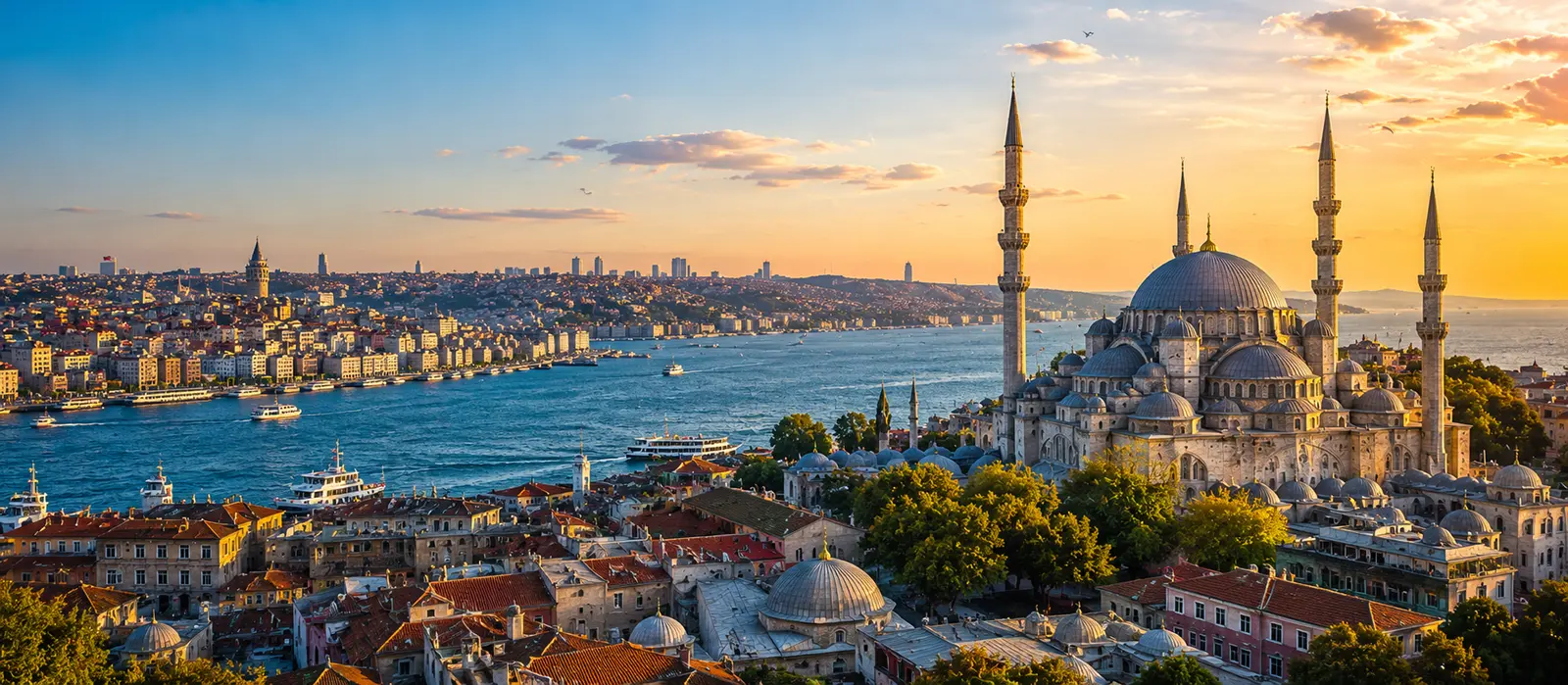
How Big Does Istanbul Really Feel Once You Arrive?
Istanbul is measured in transitions, not only in kilometers.
Istanbul feels much bigger after arrival than it looks during planning. A map can show kilometers, but it cannot fully show the effort created by water crossings, hills, traffic, station access, crowds, transfers, and neighborhoods that behave like separate city centers.
A place that appears nearby may require a tiring sequence of movements. Another place that looks distant may feel easy because one ferry or rail line connects it directly.
Istanbul is measured in transitions, not only in kilometers.
Smart Tip
Before placing two districts in the same half-day, check the route at the hour you expect to travel. Count the walk to the station, waiting time, transfers, hills, and the final walk—not only the time shown inside the vehicle. If the journey crosses water or changes transport modes, let that crossing become part of the day rather than treating it as invisible transit.
The city is large in more than one way
Physical area is only the first layer. Istanbul also feels large because its major destinations are distributed across historic, commercial, residential, cultural, and waterfront centers rather than arranged around one compact tourist core.
Sultanahmet, Beyoğlu, Beşiktaş, Kadıköy, Üsküdar, the Bosphorus villages, and newer business districts do not function like adjacent rooms in one museum. Each has its own arrival points, slopes, street logic, peak hours, and reasons for being busy.
A visitor is therefore learning several local maps at once.
Perceived distance is created by friction
Travelers often imagine distance as a fixed number. In practice, Istanbul produces frictional distance. The same geographic separation can feel short in one direction and exhausting in another.
A direct metro ride reduces decision-making. A route involving a steep descent, crowded tram, transfer, ferry wait, and final uphill walk enlarges the city psychologically even when the line on the map is modest.
The city feels biggest when the visitor must repeatedly solve how to move through it.
Water divides the map and connects the experience
The Bosphorus is not just scenery between two continents. It creates a visible boundary, but ferries and rail crossings also turn that boundary into a transport corridor. The Golden Horn adds another important division between the historic peninsula and the districts rising toward Beyoğlu.
Water changes how visitors estimate proximity. Two waterfronts may appear to face each other, yet the useful route depends on terminal locations and departure patterns. Meanwhile, districts separated by a broad stretch of water can feel naturally linked when a direct ferry joins them.
This is why Istanbul can feel fragmented from land and coherent from the deck of a boat.
| Map signal | Street reality | Effect on perceived size | Better planning response |
|---|---|---|---|
| Short straight-line distance | Water, limited crossings, or indirect streets intervene | The destination feels farther than expected | Check the actual door-to-door route |
| Long rail line | One direct connection with no surface traffic | A distant district can feel close | Use stations as itinerary anchors |
| Nearby hillside | Steep ascent, steps, cobbles, and pauses | A short walk consumes more energy | Plan direction and elevation together |
| Fast vehicle estimate | Access, waiting, transfer, and exit time are omitted | The schedule becomes compressed | Add the complete journey chain |
| Two famous districts | Each contains enough activity for many hours | The day feels larger than the route | Give each district a coherent block |
Istanbul has several centers instead of one final center
Visitors often ask which district is “the center,” expecting one answer to simplify every route. Istanbul offers several valid answers depending on whether the day concerns imperial monuments, nightlife, ferry connections, shopping, business, markets, residential life, or cultural venues.
This polycentric structure makes the city feel larger because moving between purposes often means moving between centers. The tourist does not repeatedly return to one universal square from which everything radiates.
The reward is variety. The cost is that one hotel cannot be equally close to every version of Istanbul.
Traffic changes the meaning of a kilometer
Road distance has no stable emotional value when congestion changes by hour, direction, weather, events, and bottlenecks. A taxi route that appears simple may consume a disproportionate part of the day, while a rail alternative travels beneath or around the same pressure.
This uncertainty makes road-based planning fragile. Visitors leave less margin because the route looks short, then discover that arrival time cannot be predicted from distance alone.
Traffic does not merely delay the itinerary. It makes the city feel elastic.
Hills turn horizontal maps into incomplete maps
Digital maps flatten the city. Legs do not. A route through Galata, Cihangir, Balat, Üsküdar, or streets descending toward the water can involve gradients that change pace, comfort, and willingness to make another stop.
Walking downhill toward a ferry may feel effortless; returning on the same line can feel like a different journey. Luggage, heat, rain, cobbles, mobility needs, and crowded pavements amplify the difference.
Elevation is therefore part of distance, even when the route planner reports the same number of meters.
Transfers enlarge journeys through decision fatigue
Changing from tram to metro, metro to ferry, or rail to a steep walk requires attention. The visitor must identify the correct platform, direction, exit, terminal, and final street while also watching time and belongings.
None of these decisions is individually dramatic. Repetition creates fatigue. After several unfamiliar transfers, the next district can feel farther away before the journey even begins.
Direct routes reduce more than minutes; they preserve mental energy for the place at the end.
A ferry can make a crossing feel shorter than a faster route
Time inside a ferry is usually experienced differently from time inside road congestion. The passenger can see the route, sit or stand with more spatial awareness, watch the skyline change, and understand where the two shores sit relative to each other.
The crossing supplies orientation and experience at the same time. Even when another route is faster on paper, the ferry may feel less like lost time.
This is one of Istanbul’s unusual reversals: a visible geographic barrier can produce the city’s most legible journey.
Familiarity gradually shrinks the city
On the first day, every station name and transfer demands attention. After several rides, a visitor begins to recognize which lines run along useful axes, which ferry terminals connect naturally, and which exits avoid an unnecessary climb.
Repeated routes become shorter psychologically because uncertainty disappears. Kadıköy no longer feels like an expedition from the European side; it becomes a known crossing with a recognizable arrival rhythm.
Istanbul does not physically contract. The traveler builds a usable mental network inside it.
Trip length changes which Istanbul appears manageable
During a two- or three-day stay, the city can feel impossibly large because every choice excludes many alternatives. A week allows neighborhood days, slower crossings, weather adjustments, and returns to places that deserved more time.
Longer visits do not make comprehensive coverage realistic. They make selection less anxious. The visitor can stop treating every movement as a race against an invisible master list.
A short trip needs a smaller geographic promise, not a faster body.
| Trip pattern | How Istanbul may feel | Useful structure | Common mistake |
|---|---|---|---|
| First day | Overwhelming and difficult to orient | One district plus one simple connection | Testing the entire transport network immediately |
| Three-day visit | Larger than the available time | Three coherent geographic clusters | Combining both shores with several distant attractions daily |
| Seven-day visit | Broad but increasingly legible | Neighborhood days with flexible crossings | Assuming more days require more attractions |
| Repeat visit | Smaller along known routes, larger in new areas | Keep one familiar anchor and add new edges | Reproducing the first itinerary |
| Mobility-sensitive trip | Expanded by slopes and station access | Direct routes, verified entrances, planned rests | Trusting distance without checking terrain |
Neighborhood days make the city usable
Planning by district reduces repeated travel and allows streets between major stops to become part of the experience. Sultanahmet and nearby parts of the historic peninsula can form one cluster; Karaköy, Galata, and parts of Beyoğlu another; Kadıköy and Moda another.
The boundaries need not be rigid. The principle is to avoid crossing the city for each isolated attraction when nearby places could create a fuller day.
Clustering does not make Istanbul small. It makes its largeness productive.
Your hotel changes the apparent shape of Istanbul
A hotel near a useful transport interchange gives the city several direct branches. A hotel close to one famous attraction but far from the routes used on later days can make every other district feel remote.
The correct location is not the point closest to the largest number of pins. It is the place that reduces friction across the actual itinerary, including evenings and the return journey.
Hotel geography becomes daily psychology after the third unnecessary transfer.
Use six checks to estimate how large a day will feel
- Door to door: How long is the complete route, including station access and the final walk?
- Transfers: How many times must you change line, vehicle, platform, or terminal?
- Terrain: Does the route climb, descend, cross cobbles, or require long station corridors?
- Timing: Will rush hour, attraction closing times, or ferry frequency compress the plan?
- Energy: How demanding are the attractions before and after the journey itself?
- Coherence: Could nearby streets, markets, parks, or waterfronts turn the destination into a complete block?
Do not try to defeat the city’s scale
Some visitors respond to Istanbul’s size by accelerating: more taxis, tighter reservations, shorter meals, and constant movement between distant pins. This can increase exposure while reducing memory.
The city rewards a different response. Select fewer geographic promises, learn a small number of useful transport axes, and allow crossings to reveal relationships between districts.
Missing parts of Istanbul is not evidence of failed planning. It is an honest consequence of encountering a city with many legitimate centers.
Istanbul feels largest before it becomes relational
At first, districts appear as scattered names separated by uncertain journeys. Later, the visitor understands that Eminönü faces ferry routes, Karaköy sits between water and steep streets, Marmaray changes cross-continental logic, and familiar stations open predictable paths.
The important shift is from counting places to understanding connections. Once those relationships become visible, Istanbul remains immense but stops feeling shapeless.
The city’s real size is not how much ground it occupies, but how many different worlds can exist between two ordinary stops.
Did You Know?
The Bosphorus is not Istanbul’s only defining water line. The Golden Horn separates the historic peninsula from the districts rising toward Beyoğlu, while the Sea of Marmara forms the city’s southern waterfront. A visitor can therefore cross, follow, or look across different bodies of water in the same day without leaving Istanbul.
Jean Mustafa Kowalski Nakamurason Hernández Obromoviç
Always Local
“I confirmed that Istanbul was manageable because all my destinations fitted on one phone screen. The city then introduced water, hills, traffic, three transport modes, and a station exit in another postal philosophy. By dinner, I had traveled nine centimeters across the screen and developed the emotional range of an ocean explorer.”
Who is this guy?