
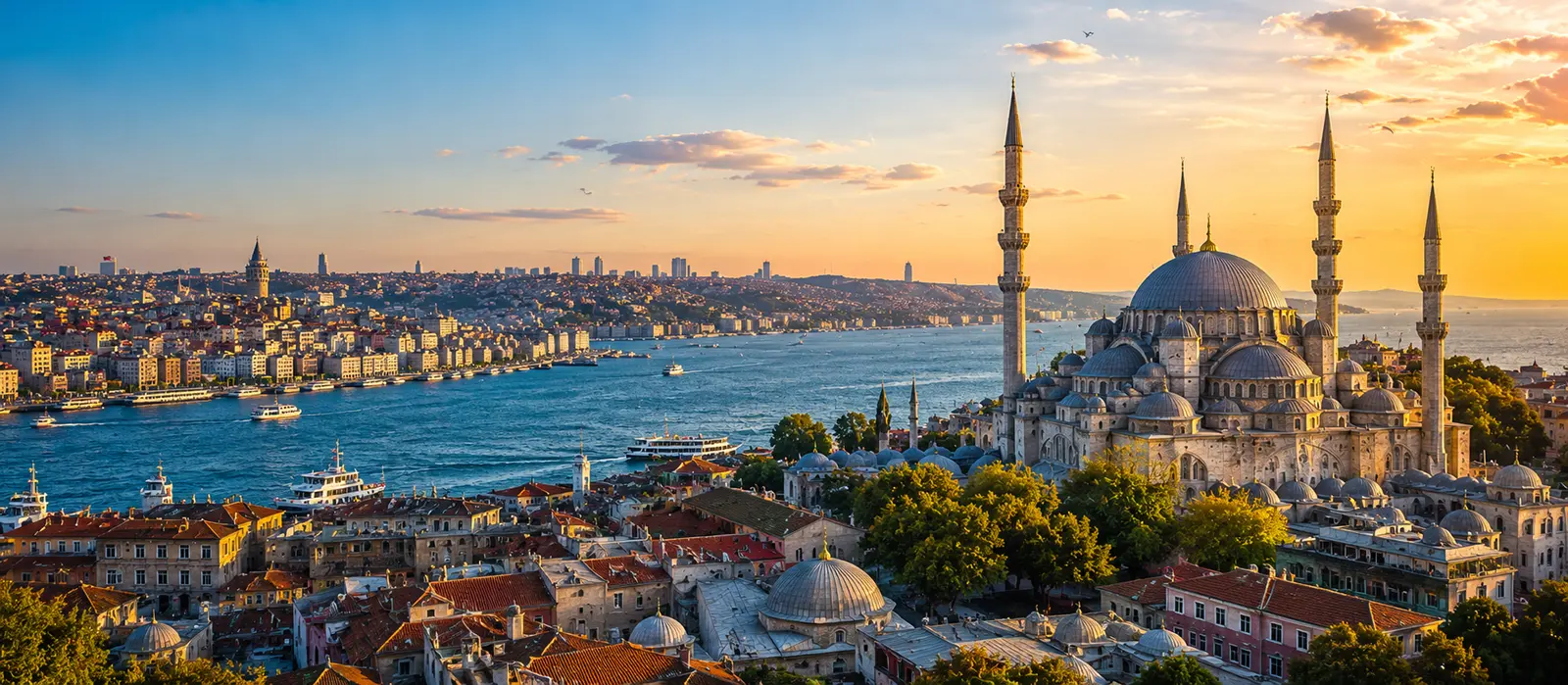
Is Skipping the Asian Side One of the Biggest Travel Mistakes?
Crossing the Bosphorus changes more than the visitor's continent.
Yes—for many first-time visitors with at least three days, skipping Istanbul’s Asian side can be one of the trip’s biggest mistakes. The loss is not the novelty of standing on a second continent. It is the absence of a powerful comparison.
The European side contains many of Istanbul’s internationally famous monuments. The Asian side shows how the city can remain central, historic, crowded, creative, residential, and deeply connected without organizing itself around the same visitor landmarks.
Crossing the Bosphorus changes more than the visitor’s continent.
Smart Tip
Do not cross to the Asian side only for a terminal photograph and the sentence “I visited two continents.” Choose either Kadıköy–Moda or Üsküdar as a coherent half-day or evening. Let the ferry, waterfront, market streets, food, and neighborhood walking form one connected experience before returning.
The real mistake is confusing fame with completeness
Sultanahmet, the historic peninsula, Galata, Beyoğlu, Beşiktaş, and the European Bosphorus can easily fill a first itinerary. Their concentration of monuments, hotels, tours, museums, nightlife, and recognizable images makes them appear to contain the essential city.
They contain essential parts of Istanbul, but not a complete model of it. When the visitor remains only on one side, differences in transport culture, waterfront use, food streets, residential patterns, evening pace, and local centrality remain abstract.
The itinerary may be full while the interpretation stays narrow.
Famous attractions create their own geographic pull
Internationally recognized monuments influence hotel choice, route planning, search results, guided tours, and the order in which districts are considered. This creates landmark gravity.
The Asian side can appear optional because its importance is less concentrated in a short list of globally famous buildings. Its value is spread across streets, markets, ferry terminals, waterfronts, cafés, cultural venues, residential areas, and the rhythms connecting them.
A district does not need a world-famous monument to be central to the city that surrounds it.
The crossing itself explains Istanbul
A public ferry turns the Bosphorus from a scenic object into working infrastructure. Commuters, students, shoppers, families, and visitors share a route that connects shores rather than separating them.
From the water, the skyline becomes relational. Minarets, towers, hills, palaces, terminals, apartment blocks, and bridges occupy one field of view. Places previously experienced as isolated attractions begin to look like parts of a waterfront system.
The journey therefore supplies orientation, transport, and interpretation at the same time.
| Common assumption | What the Asian side reveals | What skipping it removes | Useful response |
|---|---|---|---|
| The major city is on the European side | Kadıköy and Üsküdar function as major centers | A broader understanding of centrality | Give one center several connected hours |
| The Bosphorus is mainly a view | Water is part of ordinary public transport | The city’s practical relationship with the sea | Use a public ferry as part of the route |
| History is concentrated around monuments | Historic layers continue through neighborhoods and shorelines | History outside the monumental frame | Observe streets between named stops |
| Crossing continents is the main point | Daily life matters more than the continental label | A meaningful neighborhood experience | Move beyond the arrival terminal |
| One side can represent the whole city | Different shores organize time and public space differently | The contrast that makes Istanbul legible | Compare, rather than rank, the two sides |
Kadıköy offers a different form of centrality
Kadıköy does not feel peripheral when approached through its ferry terminal, transport connections, market streets, restaurants, cafés, cultural venues, and dense pedestrian movement. It operates as a destination and a distribution point for a much wider part of the city.
This changes the visitor’s mental map. Central Istanbul is no longer defined only by imperial monuments, major tourist squares, or the commercial axis around Beyoğlu. A center can also be created by everyday movement, food, social life, transit, shopping, and neighborhood loyalty.
Kadıköy is useful because it does not try to reproduce Sultanahmet.
Moda becomes valuable when it is not treated as an extra pin
Moda works best as an extension of Kadıköy’s rhythm rather than a rushed attraction. The transition from busy market and transport streets toward residential roads, cafés, parks, and the shoreline shows how the district changes without requiring a dramatic landmark.
A hurried visitor may ask what there is to “see.” A slower visitor notices how people use public space, where the pace relaxes, and how the waterfront supports ordinary leisure rather than only sightseeing.
The destination is the changing texture between places, not one compulsory photograph.
Üsküdar creates contrast without demanding nightlife
Visitors who associate the Asian side only with Kadıköy’s food and evening energy miss another useful route. Üsküdar combines ferry movement, mosque architecture, markets, local transport, residential connections, and direct views across the Bosphorus.
Its appeal can be quieter without being empty. The district gives visitors a different relationship with the historic skyline: instead of standing beneath famous monuments, they see those forms across water and understand their position within a larger city.
Distance becomes a tool for perspective.
The Asian side changes the food map
Crossing the Bosphorus should not be reduced to searching for one supposedly definitive restaurant. The stronger lesson comes from the concentration and variety of bakeries, market stalls, fish sellers, casual eateries, dessert shops, modern cafés, and neighborhood businesses serving different daily demands.
Food reveals who a street expects to feed, at what hour, and for what purpose. A market lunch, waterfront tea, bakery stop, and evening meal can show more about local rhythm than a list of famous dishes.
The value lies in observing the food environment, not claiming that one shore is automatically more authentic.
Evening can justify the crossing more than midday
Many first itineraries schedule the Asian side as a brief daytime excursion, then return before the district’s evening identity becomes visible. Kadıköy and Moda can grow more socially expressive as work ends, tables fill, waterfronts attract walkers, and cultural venues begin their programs.
Üsküdar may reward a different evening: changing light, commuter movement, waterfront views, and a calmer return across the Bosphorus.
Choosing the time according to the desired rhythm matters more than collecting both districts in one rushed sweep.
One Asian-side stop cannot represent the entire shore
The phrase “Asian side” is convenient but misleadingly singular. Kadıköy, Moda, Üsküdar, Kuzguncuk, Çengelköy, and districts extending far beyond the visitor map do not share one personality or one purpose.
A first crossing does not complete the Asian side. It simply breaks the assumption that the shore is one distant, homogeneous alternative to the European city.
The goal is not coverage. It is enough exposure to understand that multiple Istanbuls continue eastward.
A very short visit may reasonably stay west of the Bosphorus
A traveler with one full day, a long list of historical priorities, or limited mobility may gain more from a coherent historic-peninsula visit than from forcing a cross-city achievement. Crossing only to avoid the label of “mistake” would turn useful advice into another checklist.
Even a two-day trip may require difficult choices if major sites, opening times, weather, and airport transfers already consume the schedule.
The Asian side becomes a major omission when time exists but the visitor dismisses it as irrelevant, not whenever a short trip makes selection necessary.
| Available time | Reasonable Asian-side depth | Useful route shape | Main risk |
|---|---|---|---|
| One full day | Optional if historic priorities dominate | One coherent European-side cluster | Forcing a symbolic crossing |
| Two days | A ferry loop or focused short block | Connect the crossing to an existing route | Compressing major sites to collect continents |
| Three to four days | Half-day or evening in one center | Kadıköy–Moda or focused Üsküdar | Visiting both too quickly |
| Five to seven days | One full day or two different blocks | Compare distinct districts and times | Treating the shore as a single neighborhood |
| Repeat visit | Explore beyond the first ferry centers | Build around a new neighborhood axis | Repeating only the terminal experience |
Use six questions before deciding to skip it
- Time: Do you genuinely lack a half-day, or has the European-side list simply expanded without limit?
- Purpose: Are you interested only in major monuments, or also in neighborhood life, food, waterfronts, and contemporary culture?
- Route: Could a direct ferry or Marmaray connection make the crossing simpler than expected?
- Rhythm: Would a daytime market, sunset waterfront, or evening social atmosphere add the contrast you want?
- Depth: Can you give one district enough time instead of sampling several terminals?
- Energy: Can the crossing replace a crowded attraction rather than becoming one more demand?
Do not turn the Asian side into an authenticity competition
The Asian side is often promoted as the “real” Istanbul in contrast with visitor-heavy districts on the European side. That framing replaces one simplification with another. Kadıköy and Moda also contain tourism, branding, social media trends, rising prices, and businesses shaped by outside attention.
Sultanahmet remains real; so do Beyoğlu, Beşiktaş, Üsküdar, and Kadıköy. They are real under different economic, historical, residential, and cultural pressures.
Comparison is more useful than declaring one shore pure.
The best crossing changes how the visitor reads both sides
The Asian side should not be added merely because it is different. Its strongest effect is retrospective. After experiencing another center, the visitor sees the European side more clearly: its monumental density, tourism infrastructure, nightlife concentrations, commercial patterns, and transport pressures become easier to identify.
The Bosphorus no longer divides “the city” from “the other side.” It connects several centers that define one another through movement and contrast.
Skipping the Asian side is a major mistake when it leaves the visitor with many Istanbul photographs but only one idea of what Istanbul can be.
Did You Know?
Visitors can cross the Bosphorus above the water by public ferry or below it through the Marmaray rail connection. The two journeys can link similar shores while producing completely different understandings of Istanbul’s geography: one reveals the skyline, and the other reveals how closely the continents function in daily transport.
Jean Mustafa Kowalski Nakamurason Hernández Obromoviç
Always Local
“I skipped the Asian side because my Istanbul itinerary was already complete. Then I discovered that the city had continued across the water without submitting an attraction list for my approval. I crossed reluctantly, ate for several hours, watched commuters ignore the continental drama, and returned with the administrative burden of revising my personality.”
Who is this guy?