
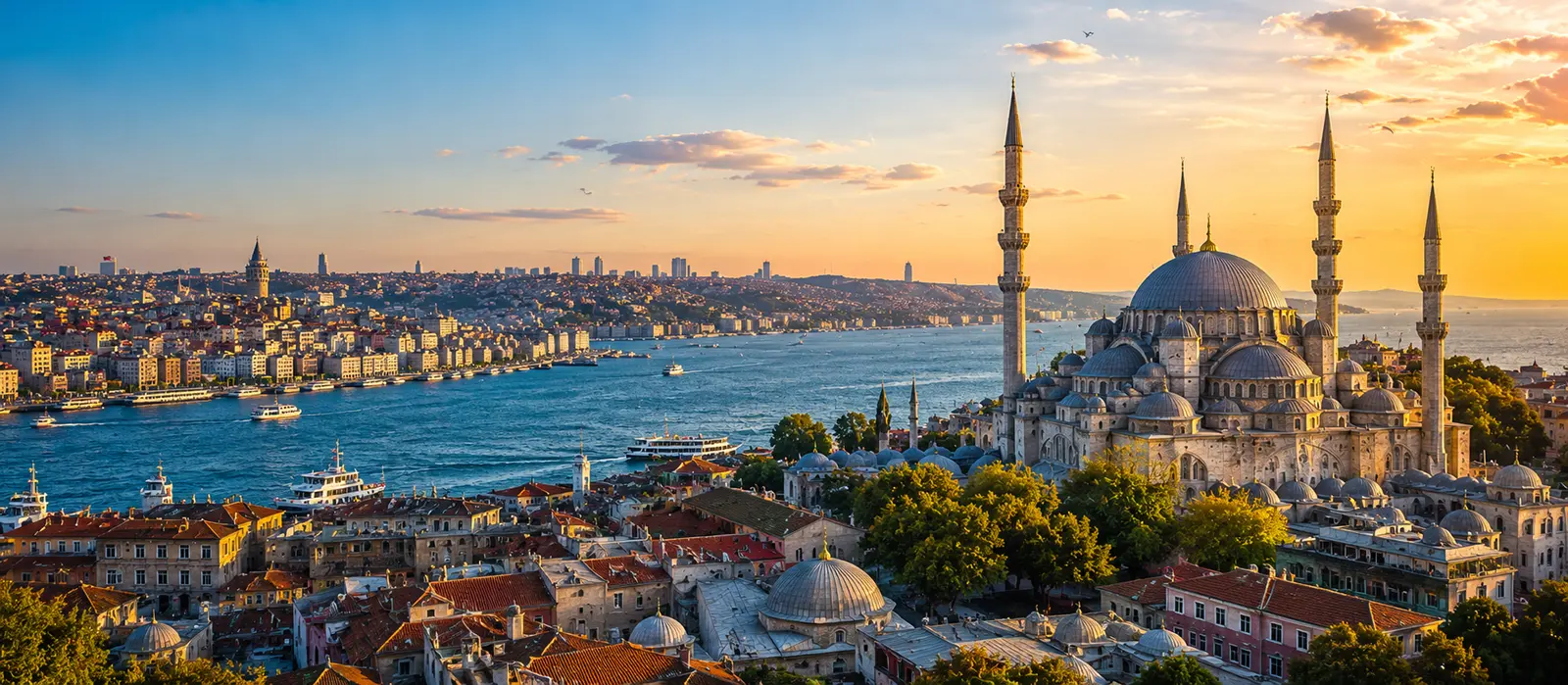
What Makes Water Transport Unique in Istanbul?
In Istanbul, the route across the water is also a way of reading the city.
Water transport is unique in Istanbul because it is simultaneously infrastructure, public space, historical continuity, and a moving view of the city. A ferry can take a commuter to work, connect a visitor with another district, bypass a congested road corridor, and reveal how the European and Asian shores relate to one another—all during the same journey.
The experience also extends beyond a single crossing of the Bosphorus. Istanbul's public ferry network reaches inner-city piers, Bosphorus neighborhoods, the Golden Horn, Marmara-side districts, and the Princes' Islands. Water is not merely the space between destinations; it is one of the city's organizing routes. That makes an ordinary ferry ride capable of changing both where a traveler goes and how the traveler understands Istanbul.
Why Is Water a Route Rather Than a Barrier?
On a flat map, the Bosphorus appears to divide Istanbul. At street level, bridges, tunnels, and distant road approaches can reinforce that impression. Ferry travel produces the opposite lesson. A passenger walks onto a pier, crosses open water, and steps directly into another neighborhood's waterfront life. The apparent boundary becomes a usable corridor.
This reversal is central to Istanbul. Kadıköy and Karaköy may belong to different continents, yet a direct sailing can make them feel like adjacent parts of one urban system. Beşiktaş and Üsküdar face one another across the water more naturally than many districts on the same side connect by road. The city's geography is therefore not simply European side versus Asian side. It is a network of shores, piers, currents, and inland connections.
Road routes must find bridges or tunnels and then distribute traffic through major arteries. Ferries can connect waterfronts without carrying every passenger through the same land bottlenecks. They do not remove the need for roads or rail, but they create another geometry: one based on direct shore-to-shore relationships.
How Does a Ferry Make the City Easier to Understand?
Underground rail is efficient partly because it hides complexity. Passengers enter one station and emerge somewhere else, often without seeing the neighborhoods between them. A ferry does the reverse. It exposes distance, direction, topography, and skyline throughout the journey.
From the deck, hills become visible as hills rather than tiring streets. Mosque domes, towers, bridges, palaces, apartment blocks, ferry terminals, industrial traces, and wooded slopes occupy one continuous panorama. Places previously stored as separate names begin to form spatial relationships. The traveler sees that Üsküdar sits opposite a particular section of the European shore, that the Golden Horn opens into the historic center, or that the Bosphorus narrows and changes character farther north.
This produces navigational visibility. The route teaches while it carries. By the time passengers disembark, they may understand Istanbul better even if they never studied a map.
| Transport mode | What the passenger experiences | What remains less visible |
|---|---|---|
| Ferry | Shorelines, direction, skyline, weather, and distance | Inland street detail beyond the waterfront |
| Metro or Marmaray | Fast, structured movement between stations | Most of the geography between entry and exit |
| Bus | Street-level neighborhoods and changing local activity | The larger relationship between distant districts |
| Taxi or car | Flexible door-to-door routing | Citywide orientation when attention stays on traffic |
| Walking | Fine detail, texture, and local scale | The broad structure of separated shores |
Why Does the Journey Feel Like a Public Place?
A ferry cabin is not only a container for passengers. It has tables, windows, doors, stairs, exterior decks, familiar sounds, and recurring rituals. Some passengers read. Others drink tea, talk, feed their attention to the gulls, stand near the rail, or quietly watch the opposite shore approach. The space supports several tempos without demanding one behavior.
This makes the ferry different from transport environments organized around urgency. A crowded platform encourages passengers to board, move inward, and prepare to exit. Road travel asks everyone to monitor delay. On a ferry, the vessel's movement continues whether passengers watch it or not. Attention is temporarily released from navigation.
The social mixture matters too. Commuters, students, families, workers, older residents, visitors, and day-trippers may share the same crossing for different reasons. The trip is ordinary enough to remain local and open enough to include outsiders. A visitor is not entering a staged performance of Istanbul but participating in one of its daily habits.
That is why tea on a ferry feels different from tea beside an attraction: the drink belongs to time already being used, not time removed from the itinerary.
How Does Water Produce Several Different Istanbuls?
Not every sailing creates the same city experience. A short Kadıköy–Beşiktaş crossing is an urban link between active centers. A route entering the Golden Horn reveals historic waterfronts, bridges, shipyards, and neighborhoods arranged along a sheltered inlet. A Bosphorus line can connect villages and districts that face the water more strongly than they face inland Istanbul. An Islands sailing gradually loosens the visual density of the metropolis.
| Water zone | Typical spatial experience | What it reveals |
|---|---|---|
| Central Bosphorus crossing | Short movement between major districts | How closely Europe and Asia function together |
| Longer Bosphorus route | A sequence of waterfront neighborhoods | The strait as a lived residential corridor |
| Golden Horn | Movement through a sheltered urban inlet | Historic layers, bridges, industry, and regeneration |
| Marmara coast | Broader water and longer coastal relationships | How far Istanbul extends beyond its famous center |
| Princes' Islands | Gradual separation from mainland density | A slower island geography within the metropolis |
The network therefore does not offer one generic “ferry experience.” Route length, pier sequence, vessel type, time of day, wind, season, and passenger purpose all change the journey. Choosing a sailing is partly choosing which geographical version of Istanbul you want to encounter.
Smart Tip
Choose the route before choosing the seat. For a short crossing, protect the side that opens toward the skyline you want to observe; for a multi-stop Bosphorus journey, move between the interior and deck as the shoreline changes. Always check the current timetable and return options before treating a commuter line as an open-ended cruise.
Why Is a Ferry Different From a Bosphorus Cruise?
A public ferry and a sightseeing cruise can travel across some of the same water, but they organize the passenger's relationship with the city differently. A cruise makes observation the primary product. A ferry has a destination, timetable, local users, and a role within the transport network. The view arrives as part of the practical journey.
This difference affects attention. Cruise passengers may look for named landmarks and commentary. Ferry passengers watch the city more freely: a fishing boat, a changing cloud, a school group, a waterside mansion, a ship waiting in the strait, or the choreography of docking. The absence of a prescribed highlight allows ordinary urban life to become meaningful.
The ferry is also repeatable. A traveler can cross in morning haze, return in afternoon brightness, and take the same route after sunset without receiving the same experience. The utility remains stable while the visible city changes. This combination—repeatable function and unrepeatable atmosphere—is difficult for other transport modes to match.
Does Water Transport Always Save Time?
No. Some ferry lines are frequent urban shuttles; others operate at limited times, follow several piers, or change between weekdays, weekends, and public holidays. Waiting for an infrequent sailing can erase any advantage gained on the water. A destination far inland may also require a substantial connection after arrival.
Weather and operating conditions matter. Wind, fog, storms, current conditions, maintenance, and special events can affect services. The open deck may be delightful in mild weather and uncomfortable in cold rain. A ferry route should be checked as real transport, not assumed to exist whenever the waterfront becomes visible.
- Use water confidently when the origin and destination align with active piers.
- Compare the full journey when either end requires a long bus, taxi, or walk.
- Protect the return on limited Bosphorus and Islands routes.
- Keep a rail alternative when a fixed reservation cannot absorb delay.
Uniqueness does not mean universal superiority. The ferry becomes strongest when its practical route and experiential value point in the same direction.
How Did Ferries Help Shape the City?
Regular ferry services have been part of Istanbul's life since the nineteenth century. Şirket-i Hayriye, established in 1851, helped make Bosphorus transportation regular and supported the integration of waterfront settlements with the wider city. Areas once associated strongly with seasonal residence became easier to inhabit throughout the year.
This history explains why piers often feel like neighborhood thresholds rather than isolated terminals. Shops, squares, bus stops, taxi stands, rail connections, markets, and meeting places gather around them. The ferry did not simply serve districts that already existed in their modern form; repeated service helped strengthen their relationship with central Istanbul.
The present network carries that history without turning every trip into nostalgia. Modern timetables, integrated payment, changing vessels, and new connections keep water transport operational. The tradition survives because it still solves contemporary movement, not because the city preserves it as a floating museum.
What Makes the Experience Impossible to Separate From Istanbul?
Many cities have ferries, waterfronts, commuter boats, or island services. Istanbul's distinction comes from the density of meanings compressed into the same water. The Bosphorus is an international strait, a local commute, a historical axis, a neighborhood edge, and a daily visual presence. The Golden Horn and Marmara add different scales, while the Islands extend the network into another pace of urban life.
A passenger can cross continents without making the crossing ceremonial. That may be the most unusual quality of all. Europe and Asia are geographically significant, but the people around you may simply be going home. The extraordinary event is absorbed into routine, and routine gives the extraordinary event credibility.
Water transport does not merely show Istanbul from a beautiful angle. It demonstrates how the city functions through separation. Shores remain distinct, yet repeated crossings make them socially and practically connected. The ferry is unique because it turns the space that divides Istanbul into the experience that holds Istanbul together.
Did You Know?
Şirket-i Hayriye was established in 1851 to provide regular Bosphorus transportation. Its services did more than move existing residents: they helped waterfront settlements become more closely integrated with Istanbul's permanent urban life.
Jean Mustafa Kowalski Nakamurason Hernández Obromoviç
Always Local
“I boarded for transportation, bought tea for culture, changed decks for geography, photographed a gull for diplomacy, and arrived on another continent before finishing any of them. The ferry charged me for one journey and Istanbul quietly delivered four.”
Who is this guy?