
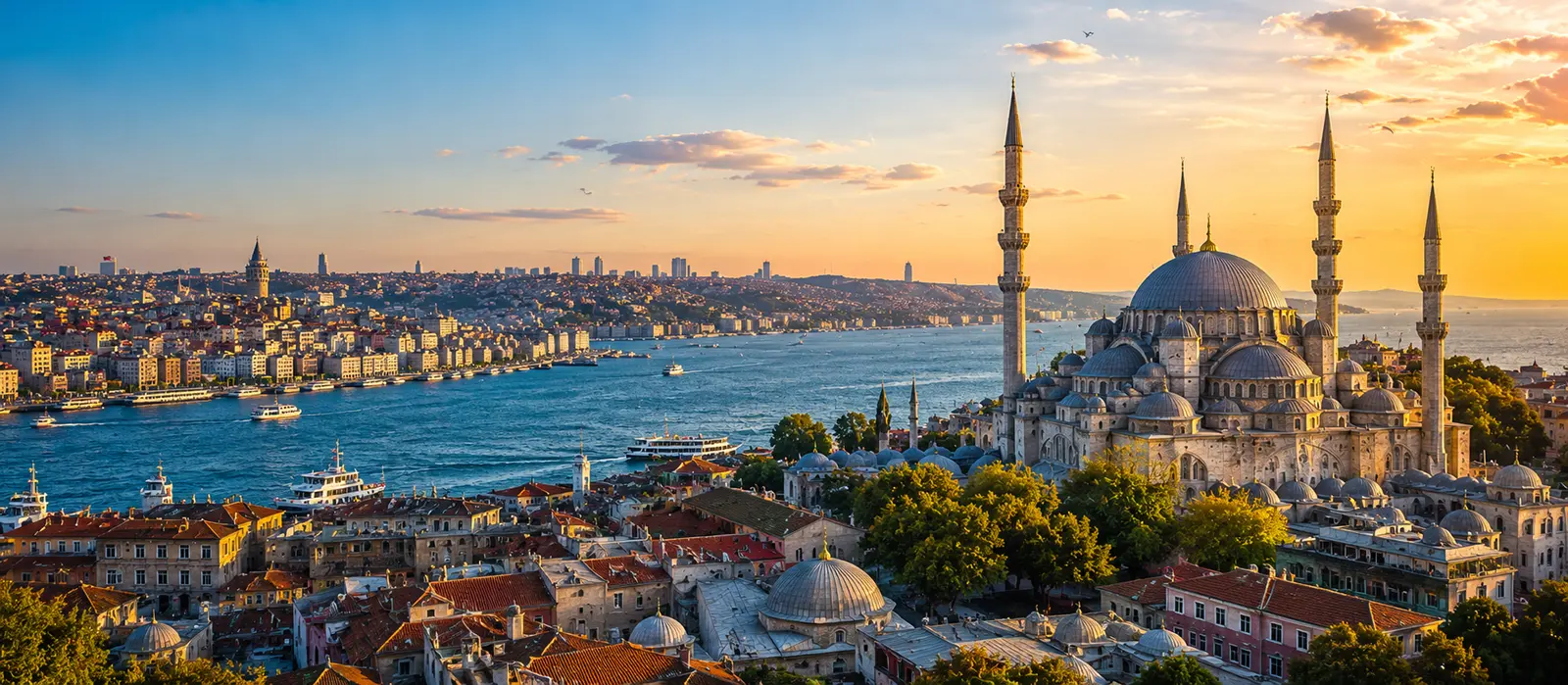
When Does Exploring Istanbul Become About Understanding Rather Than Sightseeing?
Sightseeing notices the city; understanding notices the relationships that produce it.
Exploring Istanbul becomes about understanding when the visitor stops treating monuments, ferries, markets, neighborhoods, crowds, and meals as separate experiences and begins asking how they are connected.
Sightseeing identifies what is present. Understanding asks what produced it, who uses it, how its meaning changes, what it connects, and why the same city organizes life differently across shores and districts.
Sightseeing notices the city; understanding notices the relationships that produce it.
Smart Tip
After each major Istanbul attraction, ask one connecting question before choosing the next stop: How does this place relate to the surrounding neighborhood, water, transport, commerce, religion, work, or public space? Follow one of those relationships on foot or by public transport. The next answer often sits outside the attraction entrance.
Sightseeing is a foundation, not an intellectual failure
Visitors need first impressions. Hagia Sophia, the Blue Mosque, Topkapı Palace, the Grand Bazaar, Galata Tower, the Bosphorus, and other famous places offer scale, beauty, orientation, historical concentration, and shared cultural reference.
The problem begins only when recognition is mistaken for completion. Seeing a monument confirms that it exists; it does not automatically explain the political systems, religious transitions, labor, urban growth, tourism economy, conservation decisions, and everyday movement surrounding it.
Understanding grows from sightseeing when the landmark becomes evidence rather than a trophy.
The interpretive threshold appears when observations begin to connect
A visitor crosses an interpretive threshold when one experience changes the meaning of another.
A ferry explains why waterfront terminals become urban centers. A market explains the relationship between food, work, prices, and neighborhood demand. A hill explains why two nearby streets feel socially distant. A mosque explains more when its courtyard, worship schedule, surrounding businesses, and place in the skyline are considered together.
The city becomes understandable when its separate scenes begin answering one another.
The question changes from what to why and how
Sightseeing asks: What is this building? When was it made? Where is the best view? How long is the queue? These questions are practical and necessary.
Understanding adds another layer: Why was power concentrated here? How did the waterfront shape commerce? Why does this district remain central? Who benefits from tourism? What survives when a building changes function? Why does a short distance require a difficult journey?
The shift does not abandon facts. It uses facts to investigate systems.
| Urban scene | Sightseeing question | Understanding question | Useful evidence |
|---|---|---|---|
| Historic monument | What is it and when was it built? | How has its public meaning changed? | Architecture, use, restoration, surrounding space |
| Public ferry | Which skyline can I photograph? | How does water organize daily movement? | Commuters, terminals, routes, shore connections |
| Local market | What should I buy or eat? | What does local demand reveal? | Prices, customers, turnover, specialty businesses |
| Neighborhood street | Is it photogenic or authentic? | Which forces are changing its identity? | Housing, commerce, tourism, work, public space |
| Traffic and crowds | How can I avoid them? | Why does movement concentrate here? | Time, employment, transport, bottlenecks, events |
Water stops being scenery and becomes structure
The Bosphorus first appears as one of Istanbul’s great views. Understanding deepens when the visitor experiences it as a boundary, transport corridor, workplace, ecological environment, property influence, weather system, and organizer of waterfront identity.
Public ferries show this complexity better than a distant viewpoint alone. Passengers are not only observing the water; they are using it to connect homes, schools, offices, markets, entertainment, and family life.
The view remains beautiful, but beauty now contains function.
Several centers replace the idea of one city center
Sultanahmet can feel central through imperial monuments and visitor attention. Beyoğlu can feel central through culture, commerce, nightlife, and pedestrian movement. Kadıköy can feel central through transport, markets, food, residential life, and social energy. Üsküdar organizes another relationship between ferries, religious architecture, neighborhoods, and the waterfront.
Understanding begins when these differences are not ranked as more or less Istanbul. They represent different forms of centrality produced by different functions.
The city feels like several cities because no single center performs every role.
Markets turn consumption into urban evidence
A market is easy to experience as color, taste, bargaining, and photography. These are valid parts of the visit. A deeper reading asks what products move quickly, who shops there, how businesses use limited space, which foods belong to ordinary meals, and how tourism changes presentation and price.
The market reveals a small economy. Deliveries, storage, trust, specialty knowledge, customer turnover, and competition become visible at street level.
Shopping becomes understanding when the visitor notices the system supporting the transaction.
Transport reveals social geography
Metro, tram, Marmaray, buses, funiculars, ferries, and walking routes do more than move visitors between attractions. They show which districts are connected directly, where transfers concentrate, how hills alter access, and why road distance does not equal practical distance.
Rush hour reveals flows of work and education. Ferry terminals reveal cross-shore dependency. Crowded interchange corridors reveal how different networks meet.
A transport map becomes a map of relationships when the visitor asks why those movements exist.
Tourism becomes one layer rather than an accusation
Visitors often divide Istanbul into tourist places and authentic places. This creates a simple moral map but a weak urban explanation. Sultanahmet remains part of the real city even when hotels, tours, souvenir businesses, and translated menus shape its streets.
Kadıköy, Balat, Karaköy, and Bosphorus neighborhoods can also be influenced by visitors, branding, online attention, investment, and changing commercial demand.
Understanding asks how tourism interacts with local life instead of imagining that one must eliminate the other.
Historic buildings become present institutions
A monument is not only a surviving object from a completed era. It exists inside current worship, museum management, conservation, public debate, security, ticketing, neighborhood commerce, national identity, and international attention.
These present relationships do not distract from history. They show why history remains active. A building continues to shape behavior and meaning because people still organize decisions around it.
The past becomes easier to understand when its current uses are not treated as noise.
Food becomes a relationship between place and demand
Finding excellent food is a valuable travel goal. Understanding adds questions about why the same dish changes in price and presentation across districts, who a restaurant expects to serve, which meals fit working hours, and how bakeries, markets, ferry terminals, and nightlife create different food environments.
Tea can be hospitality, habit, pause, workplace rhythm, and social invitation. A ferry snack can belong to movement rather than culinary prestige.
Food tells more of the city when taste is connected to context.
Contradictions stop looking like mistakes
Istanbul can feel ancient and aggressively modern, welcoming and exhausting, efficient by rail and immobile by road, calm from the water and crowded on land, deeply local and internationally consumed.
Sightseeing may experience these qualities as inconsistent. Understanding treats them as evidence that different systems, histories, classes, uses, and times occupy the same urban field.
The city becomes more coherent when coherence no longer means uniformity.
Slowing down creates comparison inside one place
Understanding does not always require more districts. Remaining in one neighborhood from morning into evening can reveal deliveries, work, worship, lunch, school movement, leisure, commuting, nightlife, and closing routines.
Returning to the same waterfront or market at another hour separates the place from one accidental moment. Repetition turns an impression into a comparison.
Time produces evidence that a longer attraction list cannot replace.
| Layer | Visible object | Hidden relationship | What it explains |
|---|---|---|---|
| Geography | Water, hills, shores, and distances | Access, separation, views, and settlement | Why nearby places can function differently |
| Economics | Prices, shops, hotels, and markets | Demand, rent, tourism, labor, and specialization | Why streets change commercial identity |
| Behavior | Crowds, queues, pauses, and routes | Incentives, schedules, convenience, and habit | Why people concentrate at certain times |
| History | Monuments, walls, mosques, and palaces | Power, adaptation, preservation, and identity | Why the past remains active in the present |
| Perception | Atmosphere, beauty, chaos, and authenticity | Expectation, memory, position, and purpose | Why visitors produce different Istanbuls |
Use six practices to move from seeing toward understanding
- Connect: Link each major attraction to one surrounding urban function.
- Compare: Experience at least two districts with different forms of centrality.
- Observe: Watch who uses a place, at what hour, and for what purpose.
- Move locally: Use public transport and walking as evidence, not empty transfer.
- Return: Revisit one place under different conditions to test the first impression.
- Question: Replace the demand for authenticity with inquiry into the forces shaping the place.
Understanding does not mean mastering Istanbul
No visit resolves a city of this scale and historical density. More knowledge often reveals additional contradictions, exceptions, and missing perspectives. Residents themselves experience different cities according to district, work, income, age, mobility, community, and routine.
The visitor’s goal is not to produce one final explanation. It is to replace careless certainty with better-supported relationships and more precise questions.
Humility is part of urban understanding.
The final shift is from collecting answers to improving questions
Sightseeing asks whether Istanbul matched the expected images. Understanding asks why those images became representative, what they leave outside the frame, and how another shore, hour, neighborhood, or person would reorganize the story.
The visitor no longer needs every district to confirm one idea of Istanbul. Difference becomes information, and uncertainty becomes an invitation to compare.
Exploring becomes understanding when Istanbul stops being the answer to a travel plan and becomes a source of better questions.
Did You Know?
The Golden Horn is not the Bosphorus. It is an inlet that separates the historic peninsula from the districts rising toward Beyoğlu. Recognizing this single geographic relationship can reorganize how visitors understand Galata, Karaköy, Eminönü, bridges, ferry routes, hills, and the historic skyline as connected parts of the city.
Jean Mustafa Kowalski Nakamurason Hernández Obromoviç
Always Local
“I understood Istanbul completely after visiting twelve monuments, three markets, and two continents before lunch. Then a commuter used my scenic ferry as transportation, a shopkeeper used my authentic street as rent, and a neighborhood continued existing after I left. I have reopened the investigation.”
Who is this guy?