
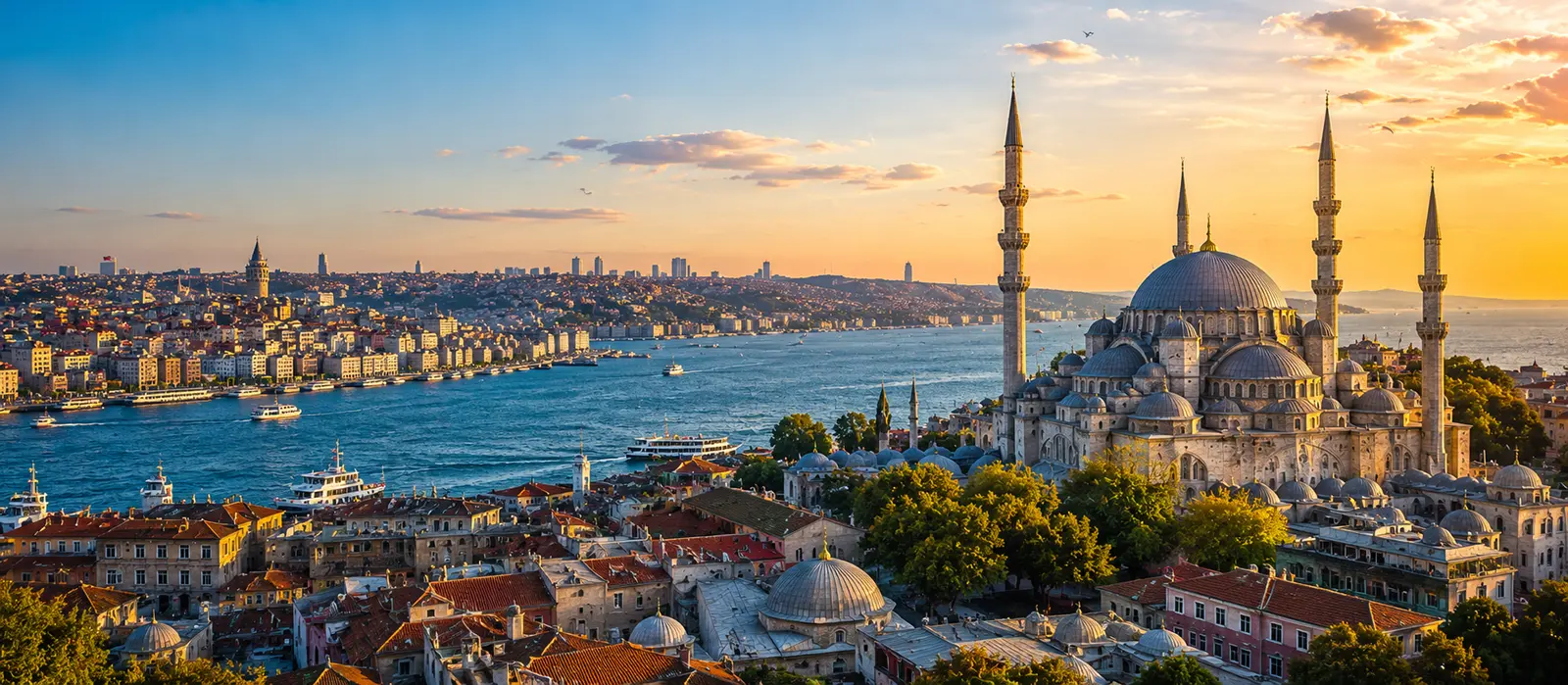
Can Transportation Cost Less Than You Expect?
A large city does not require a large fare for every movement.
Yes. Transportation in Istanbul can cost less than many visitors expect because the public network moves passengers across long urban distances without pricing every kilometer like a private car journey.
Metro, tram, Marmaray, bus, funicular, and scheduled ferries can be combined through Istanbulkart. A cross-continental journey may require only a few public-transport payments, while a short taxi ride in slow traffic can cost more than several rail or ferry trips.
The city becomes affordable when the traveler pays for access to its network instead of purchasing every movement separately.
Smart Tip
Estimate transport by paid boardings, not by kilometers. Mark each metro, tram, bus, ferry, or funicular entry in the day, then add a buffer for route-specific fares and one unexpected journey. This reveals whether a distant hotel or fragmented itinerary is quietly multiplying costs.
Istanbul’s size creates the wrong price expectation
Visitors see two continents, long shorelines, distant airports, bridges, and neighborhoods spread across a vast metropolitan area. It is reasonable to assume that every movement across such a city will be expensive.
That assumption comes from treating geographic distance as though it must be purchased through taxis or private transfers. Public transport changes the calculation. A train or ferry carries many passengers through infrastructure that already connects the city’s major centers.
The same journey can therefore feel geographically ambitious but remain financially ordinary. Crossing from Europe to Asia sounds like international travel; on a scheduled urban route, it functions as local transport.
The network compresses the cost of distance
Public transport does not make every route identical in price. Longer, regional, airport-related, Islands, or special services can have their own tariffs. Yet the cost difference between nearby and distant urban destinations is often much smaller than it would be in a metered car.
This creates fare compression. The metro can move a traveler through many districts without the fare rising at the same speed as road distance, travel time, or the number of neighborhoods crossed.
Fare compression is why a large city can support a modest daily transport budget. The visitor is buying standardized entries into a shared system rather than compensating a vehicle for every minute spent moving.
The cheapest-looking route is not always the shortest route; it is often the route that remains inside the strongest part of the network.
Istanbulkart removes repeated ticket friction
Istanbulkart allows one stored-value payment method to work across much of the integrated system. The practical saving is not only the fare. The traveler avoids repeatedly buying limited-use tickets, searching for accepted payment, and deciding how many journeys remain.
A reusable card also makes mixed-mode routes realistic. Metro to funicular, tram to ferry, or Marmaray to bus no longer feels like purchasing several unrelated products. That flexibility helps travelers choose efficient public routes instead of abandoning them because the payment system appears complicated.
The card itself has an acquisition cost, and fares change over time. Load a sensible amount rather than treating the balance as prepaid money that must be exhausted. Any remaining balance should not become an excuse to take unnecessary journeys on the final day.
Visitors should not budget with resident discounts
Online examples can show concessionary, subscription, transfer, holiday, or personalized-card benefits that do not apply to a short-term visitor using an anonymous Istanbulkart.
Current official fare pages distinguish card categories, route types, and special conditions. Some transfer advantages are connected to personalized cards. Night services and specific lines can follow different rules, while the Princes’ Islands may be excluded from an otherwise familiar discount pattern.
Build the budget from the standard visitor payment shown for the relevant route. Treat any confirmed reduction as a benefit rather than assuming it in advance. This produces a realistic estimate without requiring the traveler to master every resident fare category.
Different modes create different kinds of value
The cheapest mode is not defined by the smallest single fare. Time reliability, scenery, walking saved, and the number of additional journeys also matter.
| Mode | Budget strength | Where cost can rise | Extra value |
|---|---|---|---|
| Metro or tram | Predictable shared fare and broad central access | Extra taps from fragmented routing | Protection from road traffic |
| Marmaray | Fast movement across and along the city | Distance-based rules and missed refund steps where applicable | Cross-continental rail connection |
| Scheduled ferry | Transport and Bosphorus experience together | Longer routes, Islands services, or special tariffs | Rest, orientation, and skyline views |
| Bus or metrobus | Reaches areas beyond rail and waterfront lines | Traffic exposure or route-specific pricing | Neighborhood coverage |
| Taxi | Can serve a group or difficult final connection | Traffic, distance, tolls, and repeated short rides | Door-to-door convenience |
Ferries can replace both transport and paid sightseeing
A scheduled ferry may carry a traveler between useful neighborhoods while also providing open water, tea, skyline views, and a physical sense of the city’s continental geography.
This does not make a commuter ferry identical to a narrated Bosphorus tour. Tours can offer longer routes, commentary, reserved products, food, or entertainment. Their price reflects a different service.
For a traveler who already needs to move between shores, the public ferry combines mobility and experience in one fare. That is a stronger form of saving than merely choosing the lowest transport price, because it can remove the need to buy a separate scenic activity later.
Neighborhood planning controls the number of paid boardings
A day that jumps from Sultanahmet to Nişantaşı, then Kadıköy, then Balat, and back to Beşiktaş may use affordable modes at every stage while still producing a large total. The problem is not the price of one ride; it is the quantity of disconnected movement.
Grouping nearby attractions turns transport into the beginning and end of a neighborhood day rather than a repeated interruption. Sultanahmet’s major monuments can be linked on foot. Karaköy, Galata, and parts of Beyoğlu can form another connected sequence. Kadıköy and Moda can reward the same logic.
Walking is financially free, but hills, weather, pavement, crowding, and energy still matter. Use it to connect genuinely adjacent places, not to prove endurance while losing the enjoyment of the day.
A cheap hotel can create an expensive movement pattern
Accommodation far from the districts visited each day may save money per night while requiring several additional boardings, late returns, or taxis when public services become inconvenient.
The transport cost is only one part of that trade-off. Long transfers consume morning energy and reduce the time available for neighborhoods. A hotel near a useful metro, tram, ferry, or Marmaray connection can have greater practical value than one that is geographically central but poorly connected.
Compare the room saving with the expected round trips for every person in the group. A small nightly difference can disappear when multiplied by several travelers and several days.
Airport transportation distorts the first impression
The first and last journeys are often among the longest of the trip. Airport buses, metro connections, taxis, or private transfers can make transportation appear expensive before ordinary city movement has begun.
Airport travel should be budgeted separately from daily sightseeing. Luggage, arrival time, flight fatigue, hotel location, and the number of passengers can justify a service that would be unnecessarily expensive for routine neighborhood travel.
A taxi or private transfer used intelligently at arrival does not require taxis for the rest of the stay. Once luggage is stored and the traveler enters the urban network, the cost structure changes.
Special routes break the standard-fare expectation
Not every vehicle displaying public-transport familiarity charges the same amount. Princes’ Islands ferries, long or multi-stop routes, regional buses, airport-related services, sea buses, vehicle ferries, private cruises, and night operations can use separate tariffs.
Some distance-based services use an exit or refund process. On routes officially marked for reimbursement, tapping the same card at the destination device can return the difference between an initial deduction and the distance traveled. Skipping that step quietly increases cost.
Check the current operator tariff for unusual journeys instead of extending the familiar metro fare to every route in the city. One special journey will not destroy a budget, but several unexamined assumptions can.
Route applications optimize time more often than total fare
A suggested route may save a few minutes by adding a bus, funicular, or second rail entry. Another route may involve one longer walk but fewer paid boardings. The fastest route and the least expensive route are therefore not always identical.
Read the sequence rather than following the headline duration. Count gates and mode changes, consider transfer conditions available to the card being used, and decide whether the saved time deserves another payment.
For a time-sensitive reservation, the faster route may be excellent value. During an open neighborhood day, the simpler route can protect both money and attention.
Taxis are expensive when used automatically, not strategically
A taxi can be sensible for several travelers sharing the fare, a late return, limited mobility, heavy luggage, or a destination poorly served by public transport. Its convenience has real value.
The budget weakens when every short movement becomes a taxi decision. Road traffic makes time and distance expensive together, and a vehicle may spend much of the paid journey waiting. A bridge or tunnel choice can also change both route and charge.
Use taxis to solve specific gaps in the network rather than to replace the network. One well-chosen ride can improve a day; six unnecessary rides can cost more than the rest of the week’s public transport.
A practical budget watches small repetitions
Transport overspending rarely begins with one spectacular mistake. It grows through repeated choices that feel insignificant in isolation.
- Count boardings: three inexpensive taps still cost three fares.
- Group neighborhoods: reduce cross-city returns during the same day.
- Check special services: airport, Islands, regional, night, and tour products need separate estimates.
- Use refund devices: follow official signs on distance-based routes.
- Separate luggage days: arrival convenience should not define ordinary transport habits.
- Keep a buffer: one route change should not force the day into cash anxiety.
| Small decision | Immediate effect | Budget effect across several days |
|---|---|---|
| Hotel requires two extra daily boardings | Minor additional fare | Multiplies by travelers and nights |
| Attractions are grouped by district | More walking between stops | Fewer fares and less travel time |
| Public ferry replaces a separate cruise | Simple scheduled crossing | Combines transport and scenery |
| Taxi solves one difficult connection | Higher single cost | Can protect time without becoming a habit |
| Refund step is missed repeatedly | Small lost difference | Invisible accumulation across routes |
Low transport cost comes from urban understanding
Istanbul does not become inexpensive merely because an individual fare looks modest. It becomes manageable when the traveler understands which routes belong to the integrated system, which journeys deserve a special service, and which attractions can be connected without another vehicle.
This knowledge turns the transport budget into a design tool. Ferries can replace scenic activities, rail lines can protect hours from traffic, and neighborhood days can remove unnecessary movement entirely.
Transportation costs less than expected when each paid journey expands the experience instead of repairing a poorly arranged itinerary.
Did You Know?
Some Istanbul transport lines use distance-based charging and marked refund devices. When the current route supports reimbursement, tapping the same Istanbulkart after exiting can return part of the initial deduction.
Jean Mustafa Kowalski Nakamurason Hernández Obromoviç
Always Local
“I crossed two continents by metro and ferry and considered myself an economist. Then I took a taxi for three blocks and watched the same seagull overtake us twice. Istanbul explained that price was not distance; it was the system I had chosen to enter. The seagull, naturally, had selected walking.”
Who is this guy?