
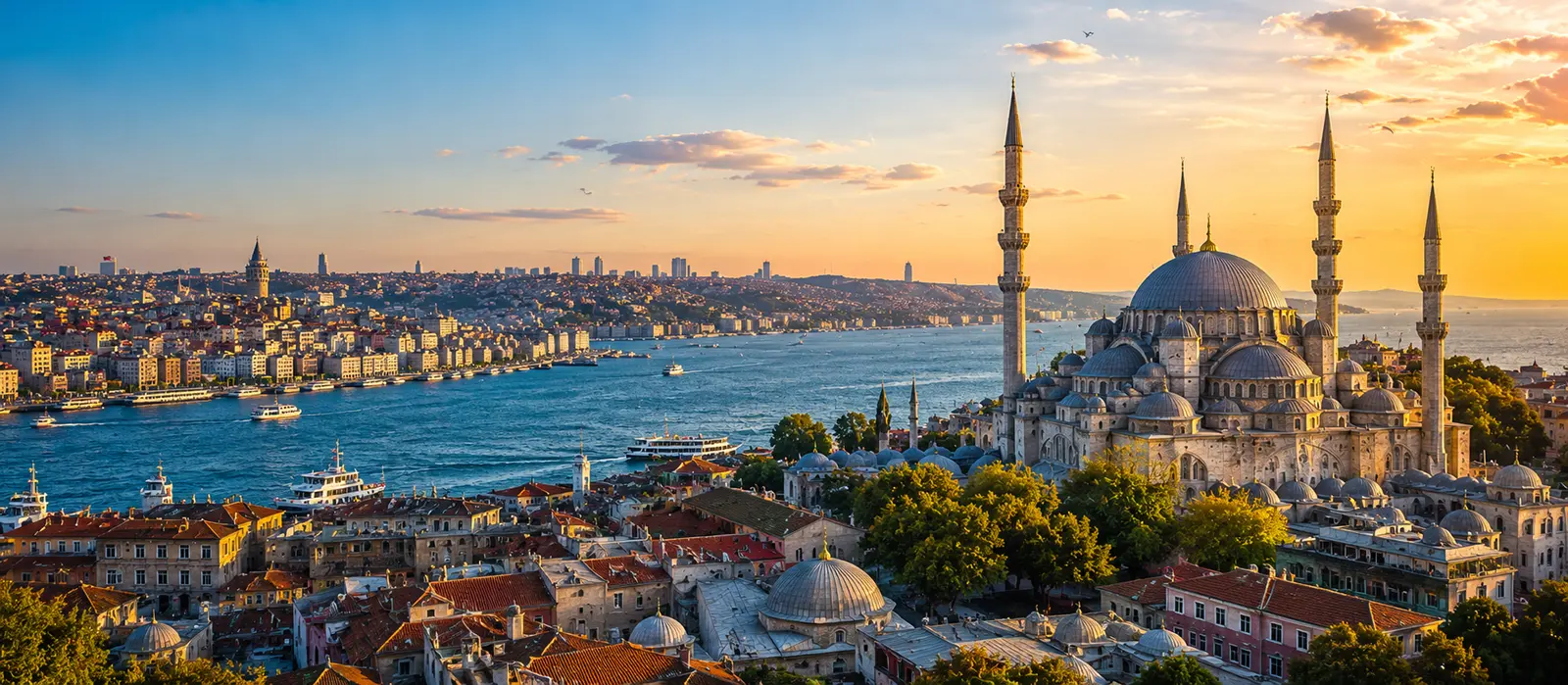
When Does Hagia Sophia Feel Most Different?
The building stays in place while time changes which part of it you meet.
Hagia Sophia feels most different during transitions: when the historic square is waking before its busiest hours, when daylight moves across the interior, when the building's active religious function becomes more perceptible, and when darkness turns its exterior into a silhouette. No single moment reveals a complete Hagia Sophia because light, sound, crowd, access, and purpose continuously change what the visitor notices.
The strongest contrast is not simply morning versus afternoon. It is monument versus living sacred space, panoramic architecture versus close material detail, and historical knowledge versus immediate sensory experience. Hagia Sophia changes most when the visitor's way of looking changes with it. A second encounter from another position or at another hour can feel less like repetition than meeting a different building.
Why Does Early Morning Change the Exterior First?
Before Sultanahmet reaches its full daytime intensity, Hagia Sophia feels more connected to the shape of the district. The square, fountains, trees, surrounding streets, Blue Mosque, and nearby walls can be read as one urban composition. Fewer competing movements allow the eye to step back from the building and understand how its mass anchors the area.
This is primarily an exterior experience. Current visitor hours, ticketing arrangements, prayer access, and conservation work may not align with dawn or the earliest quiet streets. Arriving early does not guarantee immediate interior entry. It gives the traveler a different relationship with the monument before the logistics of visiting become dominant.
The dome may appear less enormous from a photographically dramatic angle than expected because the structure builds its scale through layered buttresses, half-domes, roofs, minarets, and later additions. In a quieter square, those layers become easier to inspect. Hagia Sophia stops behaving like one famous image and begins to look like a building that has repeatedly adapted to survival.
How Does Daylight Recompose the Interior?
Hagia Sophia's interior does not receive light evenly. Windows around the dome, openings at several levels, deep galleries, massive piers, reflective surfaces, dark recesses, and changing weather create unequal zones of brightness. As the day advances, attention moves with those zones.
In softer light, the interior may feel atmospheric and less immediately legible. Dome and vault seem to hover beyond the darker structural mass. Brighter conditions can reveal marble patterns, architectural boundaries, calligraphic elements, mosaic surfaces, and the relationship between the central volume and its supporting spaces. Neither condition is more authentic; each reveals a different problem the building solves.
Season matters as much as clock time. Summer sun, winter cloud, rain, snow brightness, and haze alter both the color of the light and its direction. A recommendation based on one photograph cannot promise the same visual effect on another date. The more useful strategy is to notice where the building is bright, where it withholds detail, and how the boundary between them changes while you move.
| Moment or condition | What becomes more noticeable | What the experience may lose |
|---|---|---|
| Quiet early exterior | The building's mass and relationship with Sultanahmet | Immediate access to every visitor area |
| Bright daytime interior | Materials, decorative layers, and structural boundaries | The mystery created by shadow |
| Cloudy or soft light | Volume, atmosphere, and transitions into darkness | Strong surface contrast |
| Busy visitor period | The monument's global significance and human scale | Quiet observation and acoustic subtlety |
| After-dark exterior | Silhouette, illumination, domes, and minarets | Fine material detail |
Smart Tip
Separate the interior visit from the exterior return. Use the current official visitor route when access is available, then walk past Hagia Sophia again near sunset or after dark. The second encounter costs little time but reveals changes in silhouette, square activity, sound, and scale that one daytime entry cannot provide.
When Does an Active Mosque Feel Different From a Monument?
Hagia Sophia is not only a historical site. It is an active mosque, and that present function changes the meaning of the space. Prayer times, worship access, visitor routes, clothing expectations, quiet behavior, and temporary restrictions are not interruptions to a museum experience. They are part of the building's current life.
Active worship creates ritual recontextualization. The dome is no longer perceived only as an engineering achievement. Acoustics are no longer only an architectural quality. Orientation, open floor, voice, stillness, and collective movement reveal why the interior continues to function as sacred space.
Visitors should not use prayer as a tactic for finding a quieter attraction. Access arrangements can change around worship, and the needs of worshippers come first. The respectful approach is to check current information, follow staff instructions, keep voices low, dress appropriately, and accept that some views or areas may be unavailable.
The building feels different when you stop asking what it displays and begin noticing what it is being used for. That shift does not erase the Byzantine cathedral, Ottoman mosque, republican museum period, or later reconversion. It adds the present tense to them.
Why Does the Upper-Level View Change the Building?
The visitor gallery creates a different relationship with scale. From below, the central volume dominates and the eye rises toward the dome. From an upper level, visitors become more aware of surfaces, curvature, structural thickness, gallery circulation, and the distance between architectural layers.
Position also changes emotional authority. Ground-level perception can make the dome seem unreachable. A gallery brings parts of the building closer while revealing how far other parts remain. Details that disappear into the whole from below may become individually legible; the complete volume may become harder to absorb in a single glance.
The current separation of tourist and worship routes means that visitors should understand what their ticket and entry route actually include. An upper-gallery visit is not identical to unrestricted movement through the prayer floor, and older travel reports may describe arrangements that no longer apply. Conservation work can also change circulation or visibility.
- From a distance, read dome, half-domes, minarets, and buttresses as a changing exterior system.
- From the gallery, observe materials, mosaics, surfaces, curves, and the central void.
- From the square, compare Hagia Sophia with the urban and religious landscape around it.
- Through historical context, connect what is visible with what has been altered, covered, repaired, or reused.
Different levels do not simply offer better or worse views; they produce different explanations of the building.
How Do Crowds Change More Than Comfort?
Crowds alter attention. In a busy period, visitors monitor queues, directions, companions, photography, and personal space. The building remains present, but cognitive space narrows. People look upward briefly, follow the circulation route, and may remember the density of the visit as strongly as the architecture.
Yet a busy Hagia Sophia reveals something important: its global magnetism. Languages, reactions, clothing, guide voices, and different forms of reverence show how many cultural narratives converge on one structure. Human figures also provide scale. The piers, doors, galleries, and central volume become measurable because bodies move beside them.
A quieter period supports sustained looking and makes small sounds more noticeable. It does not automatically create a deeper experience. A visitor can waste quiet by rushing and use a crowded visit well by choosing one feature at a time. The crucial difference is whether attention is directed or continuously captured by the room.
| Changing factor | First effect | Deeper change in perception |
|---|---|---|
| Crowd density | More or less physical space | Attention shifts between architecture and social significance |
| Sound | Voices, footsteps, prayer, or relative quiet | The scale of the interior becomes audible |
| Viewing height | New sight lines | Structure changes from overwhelming volume to constructed layers |
| Historical knowledge | More names and dates | Visible elements become evidence of adaptation |
| Religious awareness | More careful behavior | The site becomes present sacred space rather than historical scenery |
Why Can Historical Knowledge Make a Second Visit Stronger?
Hagia Sophia can overwhelm first-time visitors before they understand what they are seeing. The building completed under Emperor Justinian in the sixth century, its centuries as an Eastern Roman cathedral, conversion into an Ottoman mosque after 1453, later museum period, and current mosque function create more information than one visual encounter can organize.
Learning does not replace looking. It changes which traces become visible. Buttresses become responses to structural vulnerability. Minarets and calligraphic roundels become parts of the Ottoman life of the building rather than external additions to an imagined original. Mosaics, marble, plaster, carpets, screened areas, and restoration zones become evidence that preservation has never meant freezing one date.
The nearby Hagia Sophia History and Experience Museum can provide a chronological framework, but it is a separate institution and experience. Visiting it before Hagia Sophia may make the architecture easier to decode; visiting afterward may help organize impressions already formed. Either sequence can make a later exterior return feel richer because the eye knows where to search for transitions.
What Changes After Dark?
After dark, the interior may no longer be part of a tourist visit, depending on current access arrangements, but the exterior takes on another identity. Fine textures retreat. Dome, half-domes, minarets, buttresses, illuminated windows, and the dark sky form a clearer silhouette.
The square changes too. Day-trip movement weakens, evening walkers appear, fountains and nearby façades become more visually prominent, and the relationship with the Blue Mosque can feel more theatrical. Calls to prayer and city sounds can reorganize attention across the entire historic area rather than toward one entrance.
This exterior encounter is valuable because it removes the pressure to complete a checklist. There is no mosaic to find, route arrow to follow, or ideal photograph that explains everything. Hagia Sophia becomes an urban presence—something the district lives beside after ticketed attention has moved elsewhere.
So When Does Hagia Sophia Feel Most Different?
It feels most different when two conditions overlap: the physical environment changes, and the visitor recognizes a different function or historical layer. Early quiet plus an exterior walk reveals urban scale. Shifting daylight plus patient observation reveals construction and material. The rhythm of worship reveals living religious purpose. A gallery viewpoint reveals engineered depth. Night reveals silhouette and civic presence.
The practical answer is therefore not to search for one perfect hour. Make one interior visit according to current official arrangements, then create one contrasting encounter from outside. Change either the light, distance, sound, or level. Even twenty deliberate minutes from another position can do more than repeating the same central photograph.
Hagia Sophia has survived because generations did not leave it unchanged; they used, repaired, reinforced, interpreted, and transformed it. It feels most different at the moment you realize that its changing atmosphere is not decoration around its history—it is how the building continues to have a history.
Did You Know?
Hagia Sophia's tourist and worship circulation were separated in a visitor arrangement introduced in 2024, with the upper gallery used for cultural visits. Current routes can still change during conservation work, making official same-day information more reliable than older travel accounts.
Jean Mustafa Kowalski Nakamurason Hernández Obromoviç
Always Local
“I visited once for the dome, returned for the mosaics, and came back after dark for the silhouette. Hagia Sophia remained in exactly the same place while I slowly discovered that I had been the moving part of the architecture.”
Who is this guy?