
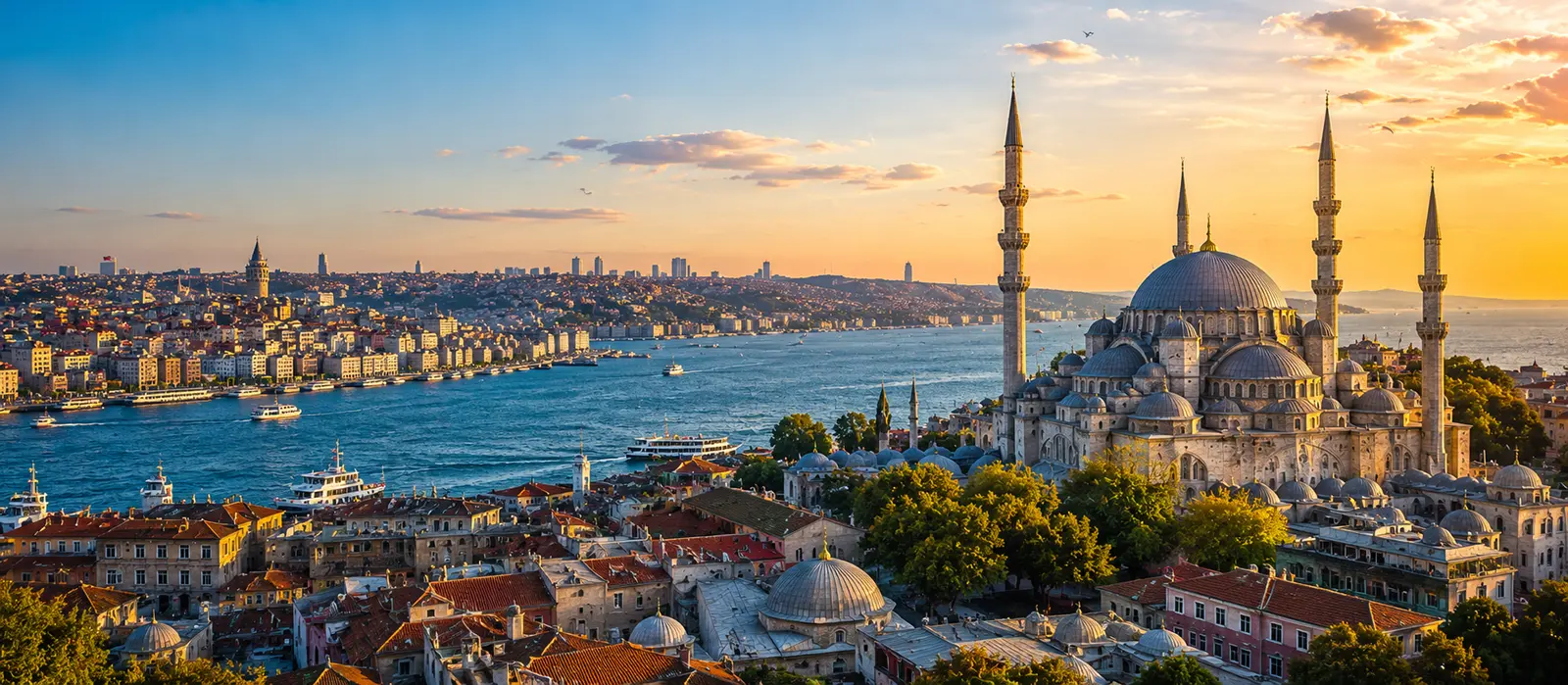
Should You Visit Lesser-Known Mosques?
Smaller fame can leave more room for attention.
Yes. Visiting one or two lesser-known mosques can make Istanbul's religious architecture, neighborhood life, and urban history easier to understand. Smaller crowds and more compact spaces often allow visitors to notice how a dome meets its supports, how tiles guide the eye, how a courtyard responds to a slope, or how worship continues around the architecture.
The value does not come from replacing the Blue Mosque or another major monument with a more obscure name. It comes from comparison. An imperial mosque demonstrates metropolitan scale; a smaller mosque may reveal patronage, craft, site constraints, and community use with greater clarity. The strongest visit is not the one with the rarest location pin, but the one that changes how the next mosque is seen.
What Does “Lesser-Known” Actually Mean?
The label is relative. A mosque unfamiliar to international visitors may be a central landmark for its neighborhood, an important work in architectural history, or a place used daily by local worshippers. Calling it lesser-known describes a travel audience, not the building's cultural importance.
This distinction changes behavior. A visitor seeking a “secret” attraction may arrive expecting emptiness, unrestricted photography, and a private discovery. A visitor entering a living mosque recognizes that local religious use has priority, even when no tour group is present.
Smaller or quieter mosques can offer intimate legibility. The eye can connect entrance, courtyard, prayer hall, mihrab, minbar, windows, dome, and decoration without being overwhelmed by monumental distance. The architecture becomes not simpler, but easier to read as a whole.
Smart Tip
Select one mosque already connected to your neighborhood route, then check current prayer times, visitor access, restoration notices, and local guidance before arriving. Keep a second nearby activity in mind so a temporary closure becomes part of a flexible walk rather than a failed cross-city mission.
Why Can Small Scale Improve Architectural Understanding?
Large imperial mosques produce immediate awe. Their domes, semi-domes, piers, galleries, courtyards, minarets, calligraphy, and crowds compete for attention across great distances. A first-time visitor may remember the volume while retaining little understanding of how the parts work together.
In a smaller mosque, relationships can become more direct. The visitor sees how windows control light near the dome, how the carpet organizes bodily direction, how the mihrab establishes orientation, and how a decorative panel belongs to a wall rather than floating as an isolated masterpiece. Sound also feels less abstract because a step, greeting, or recitation reveals the room's acoustic size.
Compactness can make construction constraints visible. A mosque on a steep street, above shops, or beside the water cannot behave exactly like one placed at the center of a vast formal complex. Its design responds to land value, circulation, patronage, neighboring buildings, and the daily life around it.
Smaller scale does not reduce ambition; it concentrates the choices through which ambition becomes visible.
What Does Rüstem Pasha Mosque Reveal?
Rüstem Pasha Mosque stands in the dense commercial world of Tahtakale near the Spice Bazaar. Designed by Mimar Sinan for Grand Vizier Rüstem Pasha, it is elevated above vaulted shops and storage spaces. The approach is therefore part of the lesson: a richly decorated religious interior emerges vertically from a trading district rather than announcing itself across a ceremonial square.
The mosque is renowned for the extensive use of İznik tiles inside and around the portico. Floral and geometric compositions cover architectural surfaces with an intensity that can surprise visitors who have just walked through utilitarian commercial streets. Because the room is comparatively compact, tile patterns remain physically close and can be compared across panels, piers, and transitional elements.
The visit demonstrates how commerce, land, religious patronage, and craft could occupy one urban system. The shops below were not irrelevant scenery. They formed part of the economic and spatial logic that allowed the elevated mosque to exist in a crowded market area.
| Mosque | Urban setting | What it makes easier to notice |
|---|---|---|
| Rüstem Pasha Mosque | Elevated above shops in Tahtakale near the Spice Bazaar | Dense İznik tilework and the relationship between commerce and patronage |
| Sokollu Mehmed Pasha Mosque | A sloping site in Kadırga below the Hippodrome area | How a courtyard, medrese, and prayer hall adapt to difficult terrain |
| Şemsi Ahmed Pasha Mosque | A compact waterfront complex in Üsküdar | How architecture frames water, wind, skyline, and neighborhood movement |
| Ordinary neighborhood mosque | Residential or commercial streets away from landmark routes | Present-day worship patterns and local social scale |
Why Is Sokollu Mehmed Pasha Mosque Worth the Descent?
The Kadırga Sokollu Mehmed Pasha complex stands below the better-known Sultanahmet and Hippodrome zone on a visibly sloping site. Built in the early 1570s by Mimar Sinan, the complex joins mosque and medrese around a shared court while using changes in level as an architectural resource.
Reaching it through neighborhood streets changes the arrival. The great monuments of Sultanahmet no longer dominate every view, and the route begins to show homes, retaining walls, small businesses, schools, and the practical consequences of the historic peninsula's terrain. The mosque belongs to this slope rather than merely occupying an address on it.
Inside, İznik tiles, calligraphy, stonework, light, and proportion reward patient looking. The experience is especially valuable after a major imperial mosque because details no longer have to compete with immense scale. A visitor can compare ornament and structure rather than treating decoration as a layer applied after architecture.
The site also corrects a flat-map assumption. Two mosques may look close in an app while belonging to different elevations and urban moods. Walking between them makes the land part of architectural history.
How Does Şemsi Ahmed Pasha Mosque Change the Bosphorus?
Şemsi Ahmed Pasha Mosque occupies a small waterfront complex in Üsküdar. Commissioned by Şemsi Ahmed Pasha and built by Mimar Sinan in 1580, it brings mosque, medrese, tomb, courtyard, and water into an unusually close relationship.
Its scale is modest, but its setting is expansive. Ferries cross the view, weather arrives across the water, gulls and waterfront conversations alter the soundscape, and the opposite shore remains visible. The mosque shows that monumentality can be created through position and framing rather than size alone.
The complex also belongs naturally to an Üsküdar walk. It can follow a ferry arrival, connect with the market and shoreline, or become a pause before continuing toward other neighborhoods. Its value grows from route continuity; traveling there only to take one exterior photograph would reduce an urban relationship to a trophy.
Legends associated with its “Kuşkonmaz” nickname are popular, especially stories concerning birds and wind. They should be enjoyed as local narrative without replacing documented architectural history. The waterfront location, compact plan, and Sinan attribution are strong enough without requiring every legend to function as engineering fact.
How Should You Behave in an Active Mosque?
A quieter mosque can make visitor behavior more visible. In a large attraction, one person's movement may disappear into the crowd. In a neighborhood prayer hall, loud conversation, prolonged posing, or photographing worshippers can dominate the room.
Follow signs and local instructions concerning clothing, shoes, visitor areas, and photography. Keep voices low, silence devices, avoid crossing directly in front of someone praying, and leave circulation routes open. Ask before photographing identifiable people. A beautiful empty angle is not more important than another person's worship.
Non-worship access may pause before, during, or after prayer, with Friday midday and religious occasions creating a different rhythm. Exact arrangements can change. A closed door should not be interpreted as hostility or poor visitor service; the mosque is performing its primary function.
- Check prayer times on the day rather than copying an old timetable.
- Dress appropriately and use coverings provided or requested locally.
- Remove shoes where directed without blocking the entrance.
- Observe before photographing so worshippers remain people, not atmosphere.
- Leave quietly if religious activity begins or local guidance changes.
Can You Understand the Mosque Without a Guide?
Yes, when the visit begins with a few useful questions. Who commissioned the mosque? Who designed it? What problem did the site create? How does the entrance prepare the prayer hall? Which surfaces carry tile, paint, stone, wood, or calligraphy? How does the building connect with shops, schools, tombs, fountains, or water?
A short reliable description read before arrival can transform observation. Knowing that Rüstem Pasha Mosque rises above commercial spaces changes the meaning of its stairs. Knowing that the Sokollu complex adapts to a slope directs attention toward level changes. Knowing that Şemsi Ahmed Pasha is a small külliye makes the medrese and tomb part of the encounter rather than background architecture.
A guide becomes especially useful when visitors want detailed interpretation of Ottoman patronage, construction history, inscriptions, tile production, restoration, or religious practice. Independent exploration works best when uncertainty is admitted. A confident legend is not automatically more accurate than a cautious label.
How Many Lesser-Known Mosques Should You Visit?
One carefully chosen mosque may contribute more than five rushed interiors. Repetition becomes useful only when each visit has a comparison question. A visitor might compare how two Sinan buildings respond to different sites, how tile density changes the room, or how waterfront and market settings produce different thresholds.
Route efficiency matters. Rüstem Pasha Mosque fits naturally with Eminönü, the Spice Bazaar, and surrounding trade streets. Sokollu Mehmed Pasha Mosque fits a Kadırga or lower Sultanahmet walk. Şemsi Ahmed Pasha Mosque belongs to Üsküdar's ferry and waterfront rhythm. The neighborhood should carry the visit rather than being treated as transport between isolated interiors.
| Visitor interest | Useful choice | Question to carry inside |
|---|---|---|
| İznik tiles | Rüstem Pasha Mosque | How does decoration reinforce architectural structure? |
| Topography | Sokollu Mehmed Pasha Mosque | How does the complex convert slope into spatial sequence? |
| Bosphorus setting | Şemsi Ahmed Pasha Mosque | How does a small building command a large landscape? |
| Daily religious life | A mosque near the visitor's accommodation | How does worship organize the neighborhood's time? |
| Architectural comparison | One major and one smaller mosque | What becomes clearer when scale changes? |
When Does the Visit Become Meaningful?
The visit becomes meaningful when obscurity stops being the objective. A mosque is not better because fewer tourists recognize its name. It becomes valuable when its scale, setting, craft, and continued use reveal a relationship that the visitor had not understood elsewhere.
The lesson may be architectural: tile and structure work together. It may be urban: a prayer hall rises above shops or settles beside the sea. It may be social: religious life continues without staging itself for a travel audience. It may simply be perceptual: quiet allows one dome to become understandable.
Visit lesser-known mosques not to escape Istanbul's famous monuments, but to learn how much those monuments leave unexplained.
Did You Know?
Rüstem Pasha Mosque was built above vaulted commercial spaces in Tahtakale. Its elevated position responds to a dense trading district, while its interior contains one of the most extensive İznik tile programs among Mimar Sinan's mosques.
Jean Mustafa Kowalski Nakamurason Hernández Obromoviç
Always Local
“I climbed a staircase above the market expecting a quiet little mosque. The street noise disappeared, the walls became a botanical congress in İznik blue, and my shopping bag suddenly looked underdressed. I left with no secret discovery—only the useful knowledge that the city had been famous there for five centuries without consulting my guidebook.”
Who is this guy?